


Two-day Seabuckthorn Conclave-cum-Reverse Buyer-Seller Meet concludes in Leh Chief Secretary calls for scientific, sustainable and industry-led approach to unlock Ladakh’s seabuckthorn potential
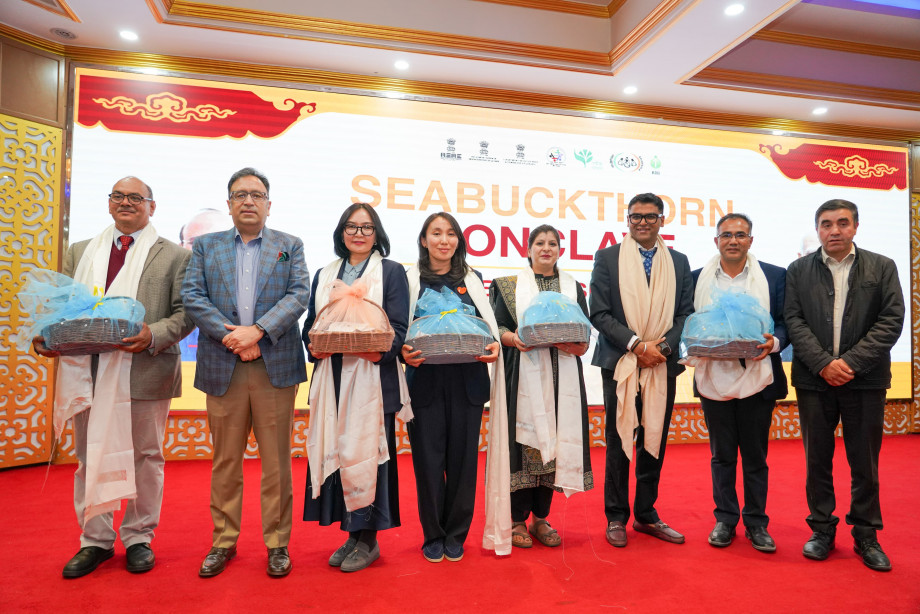
The two-day Seabuckthorn Conclave-cum-Reverse Buyer-Seller Meet 2026, organised by the Department of Industries and Commerce, UT Ladakh, concluded on September 19 at Hotel Zen, Leh, with stakeholders calling for a scientific, sustainable and industry-led approach to unlock the economic potential of seabuckthorn in the region.
The conclave brought together experts, researchers, government representatives, farmers, producers, entrepreneurs, scientists and delegates from Mongolia to deliberate on product development, value addition, certification, packaging, marketing and export opportunities for Ladakh’s seabuckthorn sector.
Chief Secretary, UT Ladakh, Ashish Kundra, attended the valedictory session as the Chief Guest, while Himanshu Gupta, Administrative Secretary, Industries and Commerce Department, was the Guest of Honour.
Addressing the session, the Chief Secretary called for a comprehensive and industry-driven strategy to develop seabuckthorn as an important economic resource for Ladakh. He emphasised increasing production and harvesting, value addition, professional branding, quality standards and stronger domestic and international market linkages.
Highlighting the importance of learning from Mongolia’s experience, Kundra appreciated the participation of Mongolian experts and stressed the need to strengthen linkages between farmers and processing industries so that benefits across the seabuckthorn value chain reach cultivators and local communities.
He also highlighted the historic and cultural ties between Ladakh and Mongolia and welcomed opportunities for greater economic cooperation between the two regions.
The Chief Secretary observed that seabuckthorn in Ladakh is largely harvested from naturally growing wild resources, while only a limited portion of the available produce is currently harvested and processed. He stressed the need to address gaps in harvesting, increase production and explore commercial cultivation, while ensuring that cultivation remains closely linked with processing and industry.
He called for a sustainable and mutually beneficial model involving farmers, entrepreneurs and industries across the entire value chain. While noting that several local entrepreneurs are already producing pulp, juice and other seabuckthorn-based products, he emphasised the need for greater scale, consistency in quality, professional branding, modern processing facilities and wider market access.
Stressing the domestic and international potential of Ladakh’s seabuckthorn, Kundra called for the development of high-quality finished products locally and exploration of export opportunities. He also underlined the ecological significance of the plant, including its role in soil protection, and called for scientific planning for its cultivation and management in suitable areas.
Drawing parallels with other important sectors of Ladakh, including apricot and pashmina, the Chief Secretary called for exploring cooperative, farmer-producer and enterprise-driven models suited to seabuckthorn. He said the objective should be to strengthen the rural economy while promoting value addition and entrepreneurship.
The Chief Secretary directed the Department of Industries and Commerce to prepare a strategy paper within one month in consultation with experts, farmers, local entrepreneurs, scientists and other stakeholders. The document will focus on increasing production and harvesting, commercial cultivation, processing and value addition, investment opportunities, quality standards, branding and market development.
He also suggested exploring institutional collaboration with Mongolia and proposed that a delegation from Ladakh could visit Mongolia to study its seabuckthorn cultivation, processing and industry models. He stressed the need to establish modern processing facilities in Ladakh to facilitate large-scale value addition and enhance the competitiveness of local products.
Kundra appreciated the field-based components of the conclave, including practical demonstrations on tools, seeding and planting practices, noting that such initiatives would help farmers and entrepreneurs adopt modern and scientific methods of seabuckthorn cultivation and management.
The second day featured technical and interactive sessions covering various aspects of seabuckthorn development. A session on product development and diversification included presentations by Dr Vidhyashankar Srivatsan of IHBT on value addition and future prospects of seabuckthorn, and Dr Parabdh Badgujar of NIFTEM on product development, followed by discussions on challenges and opportunities.
Dr Tsering Stobdan of DIHAR-DRDO, Leh, led a session on the current status, opportunities and way forward for seabuckthorn in Ladakh. A session on value addition, certification and export opportunities was addressed by Shehreen Maqbool, Regional Head, Ladakh & J&K, APEDA, who highlighted avenues for facilitating exports and expanding market opportunities.
A dedicated session on SC-ST schemes was conducted by Dr D.K. Aggarwal, providing information on schemes and support available to eligible stakeholders.
The Mongolian delegation, including Tsetsegsuvd Zagir, Head of the UVS Seabuckthorn Producer Association, and Uranchimeg Enebish, Senior Manager, Sustainable Agriculture, UVS Khuns JSC, shared experiences and perspectives on seabuckthorn production, processing and sustainable agriculture.
Rahul Tripude, Deputy Director, Institute of Packaging, Delhi, conducted a session on packaging of seabuckthorn value-added products, focusing on packaging challenges and solutions to improve product presentation, shelf appeal and marketability.
Secretary, Industries and Commerce, Himanshu Gupta, presented an overview of the proceedings and key outcomes of the two-day conclave.
The concluding technical session, led by Dr Disket Dolkar, Scientist, Fruit Science, KVK Leh, University of Ladakh, focused on assessment of seabuckthorn populations, quality germplasm and marketing potential in Ladakh.
The conclave concluded with an emphasis on strengthening linkages among producers, processors, researchers, government institutions and potential buyers to promote value addition, entrepreneurship, investment and wider market opportunities for seabuckthorn products from Ladakh.
As part of the programme, delegates also visited Leh Market, followed by a networking dinner that facilitated further interaction and exchange among stakeholders.
Secretary, School Education and Cooperatives, Bhanu Prabha, along with experts and representatives from Mongolia, farmers, entrepreneurs, scientists, researchers, and other stakeholders, attended the valedictory session.
-
 Reach Ladakh Skara Yokma, Airport Road, Near Councillor Quarter, India.


© 2018 Reachladakh. All rights reserved.
Web designs By : India Internet