


Petroglyph Park proposal aims to secure Ladakh’s ancient legacy Scientific relocation of at-risk rock art discussed to ensure long-term preservation and public awareness
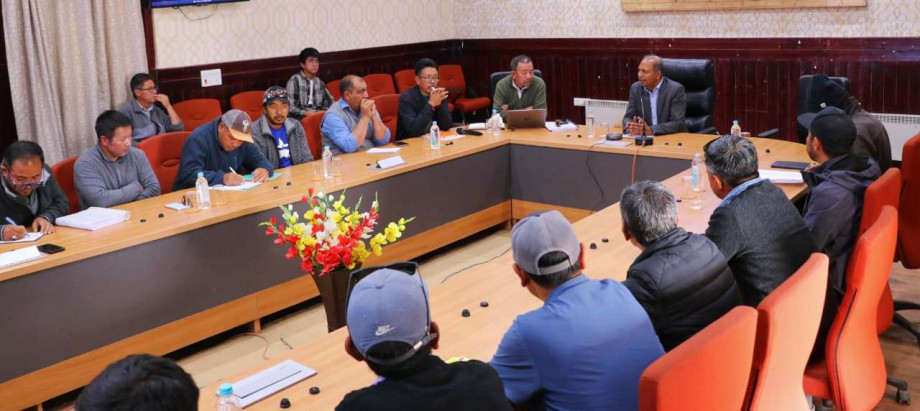
Administrative Secretary, Tourism & Culture Department, UT Ladakh, Sanjit Rodrigues, chaired a high-level consultative meeting on June 9 with Nambardars and Gobas of concerned villages, researchers, heritage experts, and members of the committee constituted for the identification and transfer of vulnerable petroglyph-bearing boulders.
The meeting was convened to discuss the proposed establishment of a Petroglyph Park at Sindhu Ghat, Leh, aimed at preserving Ladakh’s rich prehistoric rock art heritage.
Deliberations focused on the scientific relocation of endangered petroglyph-bearing rocks from various locations across Ladakh to a secure and professionally managed site. The initiative seeks to ensure the long-term preservation of these invaluable cultural assets while creating a dedicated centre for education, research, and cultural tourism.
Addressing the gathering, Rodrigues highlighted the immense cultural significance of petroglyphs, describing them as irreplaceable repositories of Ladakh’s history, traditions and identity. He emphasised that many of these ancient rock carvings face threats from natural erosion, developmental activities and other external factors, making their preservation an urgent priority.
Clarifying the intent behind the proposed project, he stated that the objective is not to remove heritage from villages but to safeguard vulnerable petroglyphs that are at risk of being lost. He assured participants that the initiative would be pursued through extensive consultation with local communities and that no decision would be imposed without their consent.
Rodrigues further noted that the proposed Petroglyph Park could serve as a major educational and cultural resource, benefiting students, researchers, visitors and local communities while promoting heritage-based tourism in the region.
Speaking on the occasion, Dr. Tashi Ladawa, Researcher and Associate Professor at Government Eliezer Joldan Memorial College, underscored the urgent need for conservation. He cited instances where valuable rock art sites had already been lost due to neglect, environmental degradation and human intervention. Noting that nearly 800 petroglyph sites have been identified across Ladakh, he cautioned that every loss represents an irreversible erosion of the region’s history and stressed the importance of systematic documentation and timely preservation efforts.
Dr. Sonam Wangchuk, Founder of the Himalayan Cultural Heritage Foundation, highlighted the broader significance of conserving Ladakh’s archaeological heritage. He informed the gathering that a committee of experts has been established to identify and document vulnerable petroglyphs requiring immediate attention, adding that nearly 200 petroglyph-bearing rocks have already been categorised as highly vulnerable.
He observed that the proposed Petroglyph Park has the potential to become the first initiative of its kind in India and could serve as a model for heritage conservation across the country.
The meeting witnessed active participation from Gobas and Nambardars of several villages, particularly Stakmo, which hosts a significant concentration of petroglyph-bearing rocks. While expressing support for the conservation of vulnerable sites, village representatives suggested that petroglyphs not facing immediate threats should be preserved in situ. They also proposed the development of village-level heritage parks and interpretation centres to strengthen local stewardship and public awareness.
Responding positively to the suggestions, Rodrigues assured that the UT Administration would extend full support to community-led heritage conservation initiatives. He encouraged village representatives to identify suitable land and submit proposals, reiterating that community participation would remain central to the preservation strategy.
Social Anthropologist Viraf Mehta also shared insights on the cultural and historical significance of petroglyphs, noting that the carvings and symbols provide valuable information about the lives, beliefs and movements of ancient communities and therefore deserve greater recognition and protection.
Participants unanimously acknowledged the importance of preserving Ladakh’s rock art heritage and stressed the need for collaborative efforts involving local communities, researchers, experts and the Administration. Nambardars and Gobas of the concerned villages expressed their support for the initiative and conveyed their willingness to cooperate in the relocation of identified vulnerable petroglyph-bearing boulders to the proposed park for their long-term preservation.
The meeting was attended by Dr. Sonam Wangchuk, Founder of the Himalayan Cultural Heritage Foundation; Dr. Tashi Ladawa, Researcher and Associate Professor; Viraf Mehta, Social Anthropologist; Gobas and Nambardars of concerned villages; the Deputy Director of the Archives, Archaeology and Museums Department; members of the Petroglyph Committee; and officials from various departments.
-
 Reach Ladakh Skara Yokma, Airport Road, Near Councillor Quarter, India.


© 2018 Reachladakh. All rights reserved.
Web designs By : India Internet