


Leh marks World Heritage Day with push to protect ancient petroglyphs
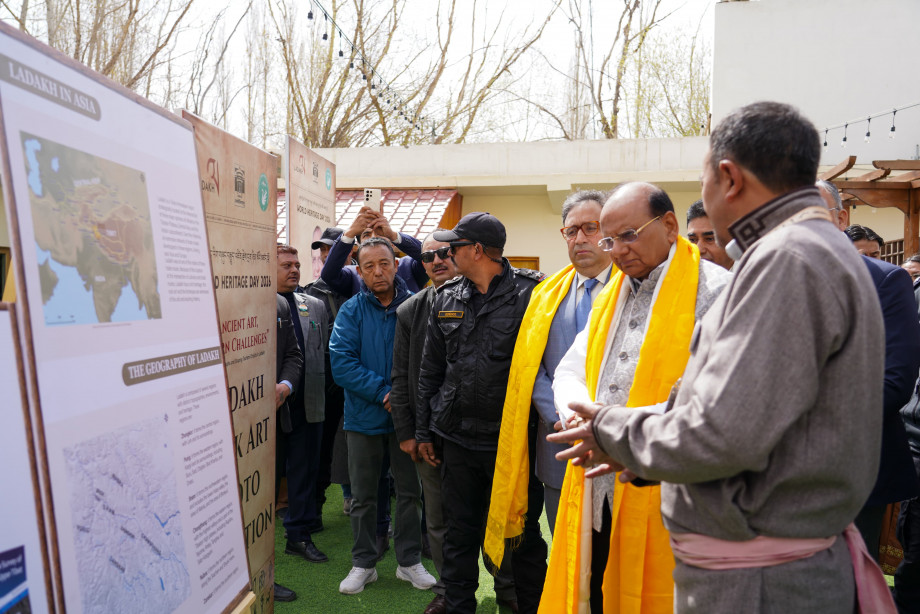
World Heritage Day 2026 was observed in Leh with great enthusiasm and intellectual engagement under the theme “Ancient Art, Modern Challenges: Safeguarding Petroglyphs and Shaping Tourism Circuits in Ladakh.”
The day-long programme was organised by the Department of Tourism & Culture, Union Territory of Ladakh, in collaboration with the Archaeological Survey of India (ASI), Mini Circle Leh, and the Himalayan Cultural Heritage Foundation (HCHF), Ladakh.
Lieutenant Governor of Ladakh, Vinai Kumar Saxena, laid the foundation stone for India’s first Petroglyph Conservation Park at Sindhu Ghat, located on the banks of the Indus River in Leh. The park is envisioned as a dedicated conservation and interpretation space for Ladakh’s centuries-old rock carvings (petroglyphs), many of which face threats from unregulated tourism, infrastructure development, climate stress, and lack of awareness.
Addressing the gathering, the Lieutenant Governor described petroglyphs as “open-air museums” and “civilisations carved in stone,” representing an unbroken record of human history from prehistoric times through later historic and Buddhist periods. He emphasised that the conservation of ancient heritage must be treated as an ethical responsibility and integrated into development planning. He also highlighted Ladakh’s significance as a repository of ancient heritage, hosting one of the most extensive collections of prehistoric rock art in South and Central Asia.
On the occasion, the Lieutenant Governor inaugurated the Ladakh Rock Art Photo Exhibition at The Zen Hotel, Leh, showcasing visual documentation of the region’s rich prehistoric and historic rock art heritage. He also released the Ladakh Rock Art Handbook, which provides comprehensive documentation of the region’s archaeological legacy and ongoing research on petroglyphs.
Following the inauguration, a one-day workshop titled “Ancient Art, Modern Challenges: Safeguarding Petroglyphs and Shaping Tourism Circuits in Ladakh” formally commenced at the same venue, featuring academic sessions and technical deliberations.
A Memorandum of Understanding (MoU) was subsequently signed between the Department of Archives, Archaeology and Museums, UT Ladakh, and the Archaeological Survey of India to strengthen institutional collaboration and promote long-term preservation and conservation of Ladakh’s heritage.
The workshop featured a series of academic and technical sessions, bringing together eminent archaeologists, scientists, anthropologists, and heritage professionals to deliberate on Ladakh’s prehistoric rock art, its cultural significance, and the challenges of conservation in the modern era.
The programme concluded with an open house session that saw active participation from community members, scholars, students, and institutional representatives. The session provided a platform for dialogue on preserving Ladakh’s rock art and broader heritage assets. Participants raised key concerns, including the need for clear preservation policies, stronger legal mechanisms to prevent vandalism, financial and technical support for local communities, inclusion of local languages in heritage outreach, protection of remote and lesser-known heritage corridors, education and curriculum reforms, and the importance of treating heritage conservation as a continuous, year-round responsibility.
The World Heritage Day 2026 celebrations concluded with a shared commitment among institutions, experts, and communities to safeguard Ladakh’s ancient art through collaboration, awareness, community participation, and sustainable planning—ensuring that this invaluable cultural legacy is preserved for generations to come.
-
 Reach Ladakh Skara Yokma, Airport Road, Near Councillor Quarter, India.


© 2018 Reachladakh. All rights reserved.
Web designs By : India Internet