


L-G Vinai Kumar Saxena launches Project Him Sarovar to strengthen water security in Ladakh Calls for collective efforts to create new “green and blue assets” for ecological balance
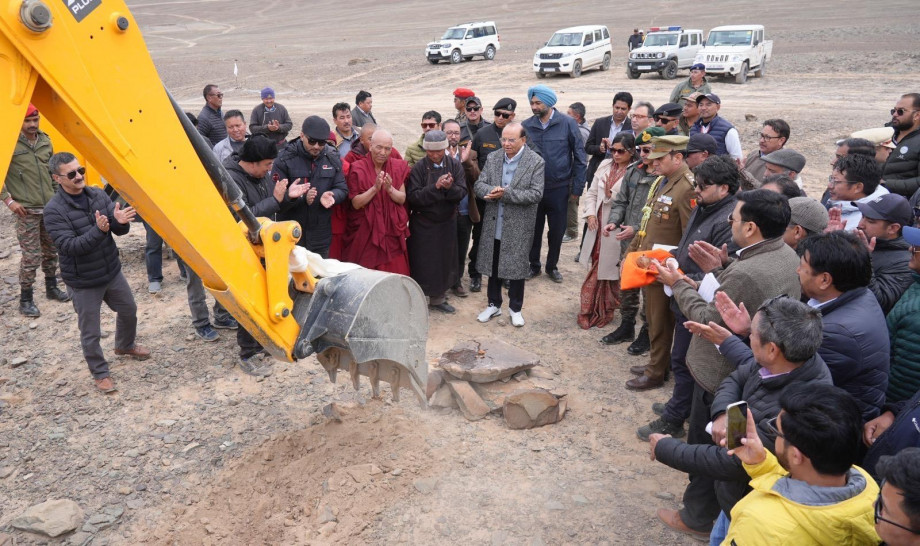
In a proactive step towards ensuring long-term water security in the cold desert region, the Lieutenant Governor of the Union Territory of Ladakh, Vinai Kumar Saxena, on April 10 launched Project Him Sarovar. The project aims to promote scientific snow harvesting and the creation of water bodies to address the pressing challenge of water scarcity in Ladakh.
The initiative focuses on harvesting snow and conserving snowmelt to strengthen water security across the region, where water availability remains a critical concern due to its unique climatic and geographical conditions.
L-G Saxena formally launched the project with the commencement of excavation work for the creation of 50 water bodies simultaneously in Leh and Kargil. These structures, measuring 40x30 metres and 2 metres in depth, are designed to store snowmelt and glacial melt that would otherwise go to waste each year, thereby providing a reliable source of water for irrigation.
Describing the initiative as historic, the Lieutenant Governor stated that Project Him Sarovar marks a decisive and scientific intervention to tackle the growing issue of water availability in Ladakh, where water is not merely a resource but a lifeline for the people.
Notably, soon after assuming office on March 13, L-G Saxena had directed the Chief Secretary to identify suitable locations and prepare an action plan for the construction of 50 small water bodies across the Union Territory.
Highlighting the importance of the project, he said it is directly linked to Ladakh’s water security and will play a crucial role in addressing irrigation challenges faced by farmers who depend on limited water sources. He emphasised that these water bodies will help conserve both rainwater and annual snowmelt, creating a dependable source of water for agricultural purposes.
He further stated that Project Him Sarovar will not only fulfil irrigation needs but also generate sustainable livelihood opportunities for local communities.
The project is being designed using scientific methods, taking into account Ladakh’s fragile ecosystem and climatic conditions.
The Lieutenant Governor noted that the initiative aligns with Prime Minister Narendra Modi’s vision of restoring 2.6 crore hectares of degraded land by 2030, contributing to broader environmental conservation goals.
He also highlighted the strong support extended to the project by various stakeholders, including the Indian Army, Indo-Tibetan Border Police (ITBP), Border Roads Organisation (BRO), and the local population, and lauded the people of Ladakh for their encouraging response.
L-G Saxena added that the project has been conceptualised in line with Ladakh’s unique geographical and climatic conditions, and that water bodies will be developed in consultation with local communities to meet specific regional needs. In addition to water conservation, the initiative will also support plantation efforts along roadsides and enhance green cover.
Addressing the broader environmental context, he pointed to the visible impacts of climate change in Ladakh, including declining snowfall, melting glaciers, rising temperatures, and falling water tables. He stressed the urgent need for sustainable water management practices to mitigate these challenges.
Underscoring the importance of preserving traditional irrigation systems alongside modern solutions, the Lieutenant Governor called for collective efforts to enhance Ladakh’s natural landscape by creating new “green and blue assets” to ensure long-term ecological balance.
-
 Reach Ladakh Skara Yokma, Airport Road, Near Councillor Quarter, India.


© 2018 Reachladakh. All rights reserved.
Web designs By : India Internet