


KVK Kargil organises Kisan Samman Diwas at Salikote
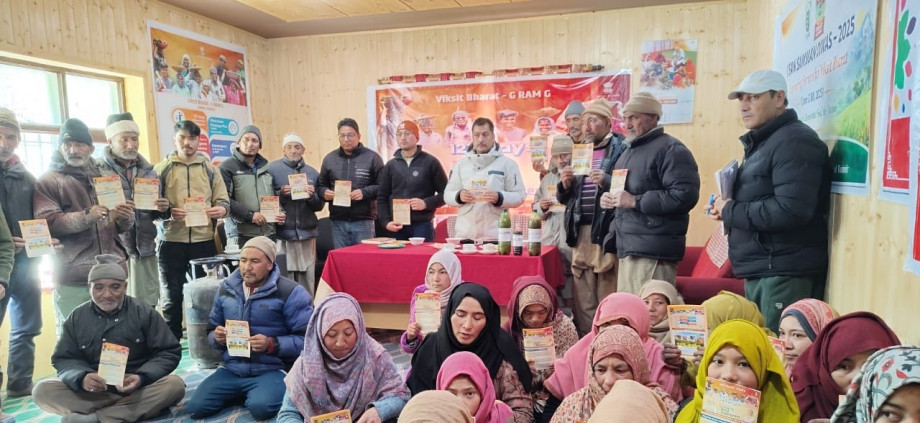
Krishi Vigyan Kendra (KVK) Kargil on December 23 organised Kisan Samman Diwas at Salikote to commemorate the birth anniversary of former Prime Minister Late Chaudhary Charan Singh.
The programme was graced by Syed Kazim Sabiri, former Executive Councillor, LAHDC Kargil, as the Chief Guest. Officers from the Agriculture Department, officials of KVK Kargil and local farmers participated in the event.
Addressing the gathering, Dr. Mansoor Hussain, Caretaker, KVK Kargil, briefed participants on the objectives of the programme and highlighted the life and vision of late Chaudhary Charan Singh. He said the former Prime Minister, himself a farmer, dedicated his life to the welfare of the farming community and introduced several landmark reforms in the agriculture sector to strengthen farmers’ livelihoods.
Dr. Hussain urged farmers to adopt agriculture as an enterprise and encouraged them to leverage modern technologies and various government schemes to enhance productivity and income. He informed that KVK Kargil has introduced several innovative initiatives, including natural farming practices, water conservation techniques such as mulching and drip irrigation, and the promotion of high-yielding varieties of vegetables and food crops.
Later, a practical demonstration on the preparation of Jeevamrit, Neem Astra and Brahma Astra was conducted to familiarise farmers with eco-friendly and cost-effective natural farming inputs for sustainable crop production.
Dr. Hussain also elaborated on the benefits of the newly enacted VB-G-RAM-G Act for the farming community. He explained that shortcomings in the earlier MGNREGA have been addressed in the new legislation, which guarantees 125 working days for rural households and brings all rural welfare works under its ambit. He said the Act would significantly empower rural communities and promote holistic rural development.
On the occasion, pamphlets highlighting the benefits of the VB-G-RAM-G Act were released by the Chief Guest and distributed among the farmers.
-
 Reach Ladakh Skara Yokma, Airport Road, Near Councillor Quarter, India.


© 2018 Reachladakh. All rights reserved.
Web designs By : India Internet