


IBC inaugurates Guru Padmasambhava exhibition on Buddha Purnima
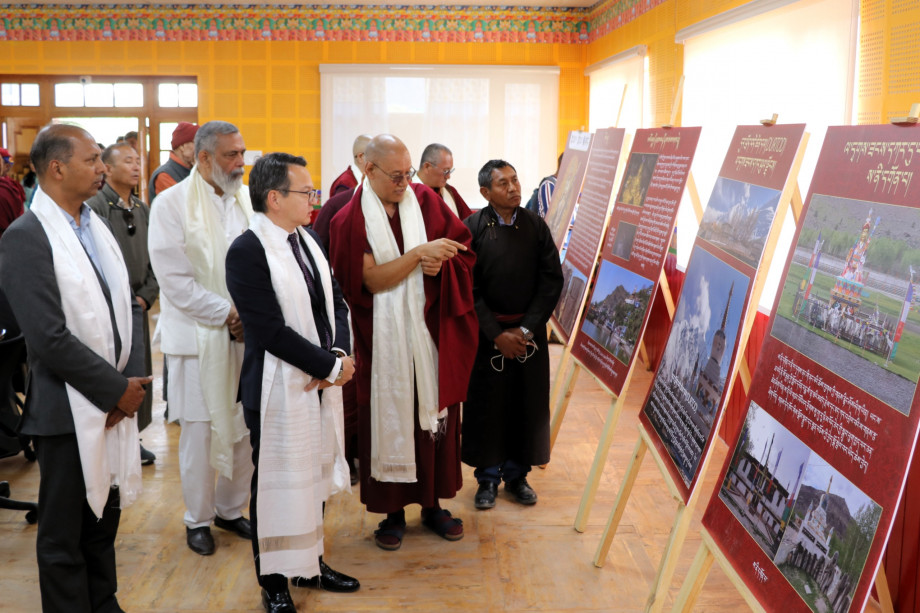
An exhibition on Guru Padmasambhava (in Bhoti) was inaugurated at the Dharma Centre by the International Buddhist Confederation (IBC) on the occasion of Buddha Purnima, in the presence of distinguished dignitaries and members of the monastic and scholarly community.
The ceremony was graced by the Ambassador of Mongolia to India, His Excellency Ganbold Dambajav; Secretary General, IBC, Shartse Khensur Jangchup Choeden Rinpoche; Director General, IBC, Abhijit Halder; Tourism Secretary, Sanjit Rodrigues, IAS; Education Secretary, Bhanu Prabha, IAS; President of the Ladakh Gonpa Association (LGA), Ven. Gyen Dorjey Stanzin; Joint Secretary, Bhoti Text Initiative (BTI); members of the Ladakh Gonpa Association; AD Tourism; and Buddhist scholars, among other delegates.
The visiting delegation first viewed a visual exhibition tracing the life and journey of Guru Padmasambhava through a series of curated illustrations depicting his timeline and enduring spiritual legacy.
Ven. Gyen Dorjey Stanzin began with an ode to Guru Padmasambhava and highlighted the significance of the occasion, which coincided with the arrival of the holy relics of Tathagata Buddha in Ladakh. He welcomed the gathering and outlined the series of programmes being organised across the region, including an upcoming Buddhist conference. He also detailed the journey of the sacred relics, noting that in their final leg they would be brought to the Dharma Centre. He expressed gratitude to the administration for its continued support in ensuring the smooth conduct of the events.
Delivering the keynote address, Ambassador Ganbold Dambajav spoke on the profound influence of Guru Padmasambhava on Buddhism in Mongolia. He described the exhibition as sacred and significant, and reflected on the historical ties between Ladakh and Mongolia, particularly through Kushok Bakula Rinpoche, who served as India’s Ambassador to Mongolia. He also recalled the long-standing tradition of Mongolian scholars travelling to Nalanda University and referred to the exposition of Buddha relics in Mongolia in the 1930s.
Highlighting renewed interest among Mongolia’s younger generation in their cultural and religious heritage, he emphasised that Buddhism is not merely a religion but a way of life. He described it as a vital pillar of India–Mongolia relations, appreciated the IBC’s efforts in strengthening these ties, and conveyed his gratitude to Prime Minister Narendra Modi, the Union Government, the UT Administration, the Dharma Centre, and members of the Sangha.
Secretary General, IBC, Shartse Khensur Jangchup Choeden Rinpoche, spoke on the life of Guru Padmasambhava and the differing historical accounts regarding his birthplace. He stressed the need for scholars to arrive at a shared understanding through dialogue and research, particularly in light of variations in historical literature. He also emphasised the importance of scientific documentation and evidence-based study of records for future generations, noting that such exhibitions play a crucial role in preserving and disseminating knowledge.
Tourism Secretary Sanjit Rodrigues described the occasion as historic and highlighted ongoing initiatives aimed at raising awareness among Ladakh’s youth about their cultural heritage and traditional way of life. He noted that the exhibition traces Guru Padmasambhava’s journey in Ladakh and reflects the deep reverence associated with him in the region. He expressed gratitude to the IBC and the Ladakh Gonpa Association for organising the exhibition.
Director General, IBC, Abhijit Halder, remarked on the auspiciousness of the day, coinciding with Buddha Purnima, and noted that Guru Padmasambhava is revered as the Second Buddha. He observed that the public exposition of the holy relics earlier in the day, followed by the inauguration of the exhibition, made the occasion particularly significant.
He further shared plans to take the exhibition across the Himalayan region and emphasised the importance of scholarly dialogue on differing historical narratives. Referring to an upcoming conference in Odisha, he described Guru Padmasambhava’s legacy as both historical and mystical, with traces evident across monasteries and meditation caves in Ladakh. He highlighted the deep spiritual connection between Ladakh and the Guru, reflected in teachings, traditions, and annual festivals, and expressed hope that the exhibition would deepen understanding of this enduring legacy.
Mementoes were presented to the dignitaries. The English version of the exhibition will be inaugurated tomorrow at the Central Institute of Buddhist Studies (CIBS), Leh.
-
 Reach Ladakh Skara Yokma, Airport Road, Near Councillor Quarter, India.


© 2018 Reachladakh. All rights reserved.
Web designs By : India Internet