


Chief Secretary holds consultative meeting with Ladakh Civil Society members
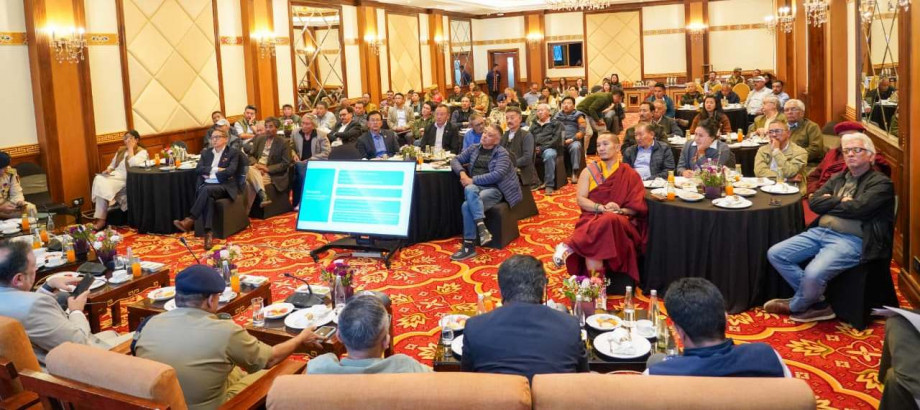
Chief Secretary, UT Ladakh, Ashish Kundra, convened a consultative meeting with members of civil society from Ladakh on September 21 to discuss key administrative, developmental and political issues concerning the Union Territory, including constitutional safeguards, land rights, employment, culture, environment, education, drug abuse and other matters of public importance.
The interaction was attended by prominent members of the community representing diverse backgrounds and sections of society, including H.E. Palga Rinpoche; former MLA Deldan Namgyal; Rigzin Dorjay from the Ladakh Buddhist Association; Mohd. Shafi from Anjuman Moin-ul-Islam; Rev. Dechen Chamga from the Christian Association; Padma Shri awardees Chewang Norphel and Morup Namgyal; Honorary Captain Tashi Tsepel, Vir Chakra; former Ambassador Tsewang Namgyal; and Kunzes Dolma from the Women’s Forum.
The meeting was also attended by Administrative Secretaries and senior government officials of the UT Administration.
Addressing the meeting, the Chief Secretary said there was broad agreement on the need for constitutional protection for Ladakh. He said the protection should cover land, employment, culture, environment and natural resources.
He informed the participants that a new framework was being worked out under Article 371 to provide constitutional safeguards suited to the specific requirements of Ladakh. He said the proposed model was being developed considering the aspirations of the people of Ladakh and that it would be distinct from existing arrangements elsewhere in the country. He further said the draft would be discussed at the next meeting proposed to be held in the first week of October. Recent discussions between the Ministry of Home Affairs and representatives of the Leh Apex Body and Kargil Democratic Alliance have also focused on a proposed elected UT-level body and the distribution of powers between it and the LAHDCs.
The Chief Secretary said direct elections to the proposed UT-level body were among the key suggestions emerging from the discussions. Further steps, including consideration of the proposed constitutional amendment by Parliament, would follow after consensus is reached on the framework. He also explained that separate legislation would subsequently be required to provide detailed provisions regarding the powers, functions and institutional arrangements of the proposed body.
The Chief Secretary also highlighted various recent administrative initiatives, including strengthening of the district-level administrative structure, posting of officers in the districts, upgradation of hospitals to district hospitals and progress towards Panchayat elections. He further informed the participants that Ladakh had recorded more than four lakh tourist arrivals so far this year, compared to around 3.35 lakh during the entire previous year.
The meeting also featured presentations on a range of developmental and social issues concerning Ladakh. DGP Ladakh Anand Jain, on behalf of the Ladakh Police, made a presentation on drug-related issues and sought the support of civil society members in creating awareness among the public. He expressed concern over the rising number of drug-related cases in Ladakh. Dr. Padma, Psychiatrist at SNM Hospital, also made a detailed presentation on drug abuse, highlighting various aspects of the issue and the need for greater awareness and intervention.
Commissioner Secretary, Forest, Ecology and Environment, Dr. Franklin, gave a detailed presentation on wildlife sanctuaries and settlement rights, while Divisional Commissioner/Revenue Secretary Shurbir Singh briefed the participants on the draft Conferment of Ownership and Land Rights.
Secretary, General Administration Department, Rudra Gaud, presented the employment status in the UT of Ladakh. Secretary, Higher Education, School Education and Cooperative, Banu Prabha, made presentations on educational transformation as well as the cooperative and dairy sectors.
Actively participating in the discussions, members of civil society put forth their views, suggestions and feedback on drug abuse, the draft Conferment of Ownership and Land Rights and other important issues.
Several participants appreciated and thanked the UT Administration and the Chief Secretary for facilitating the interaction and suggested that such consultative meetings should be held regularly in the future.
Noting the valuable feedback and suggestions received from the participants, the Chief Secretary said that similar interactions would be organised in the future as well. He urged members of different sections of society to continue putting forth their suggestions and feedback directly before the concerned departments and offices.
-
 Reach Ladakh Skara Yokma, Airport Road, Near Councillor Quarter, India.


© 2018 Reachladakh. All rights reserved.
Web designs By : India Internet