


Amit Sharma unveils Census 2027 roadmap in Ladakh; announces two workstations to boost grassroots planning
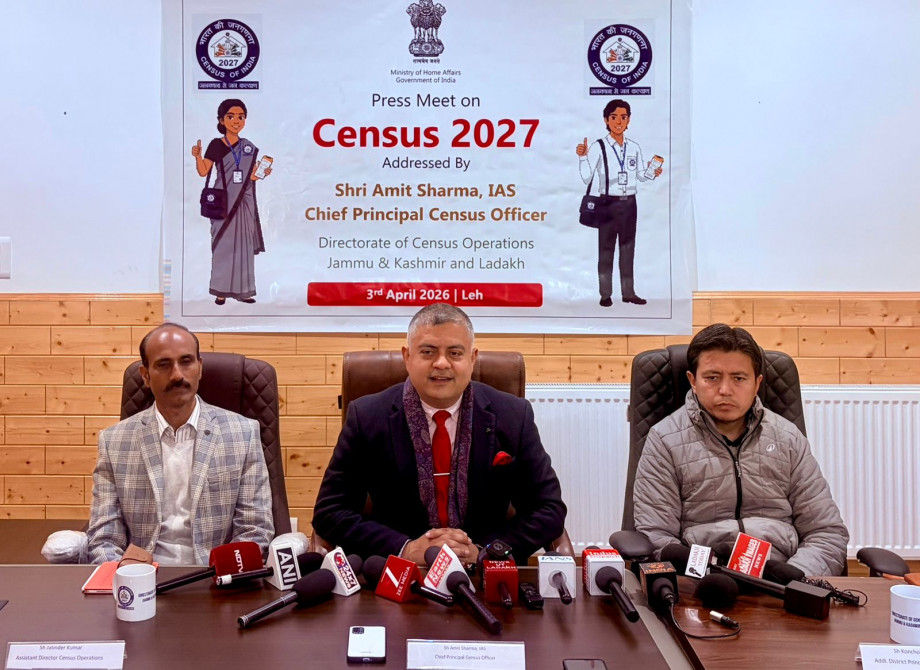
Amit Sharma unveils Census 2027 roadmap inChief Principal Census Officer (CPCO) and Director of Census Operations (DCO) for Jammu & Kashmir and Ladakh, Amit Sharma (IAS), on April 3 unveiled the roadmap for Census 2027, describing it as a transformative exercise set to redefine data-driven governance in the Union Territory of Ladakh.
Highlighting a key milestone, Sharma said that Census 2027 will be the first Census conducted in Ladakh since it attained Union Territory status in 2019. He termed it a significant opportunity to generate accurate and comprehensive data, enabling targeted development and informed policy interventions in the region.
Addressing media persons, he informed that Census 2027 will be India’s first fully digital Census, leveraging advanced technology for efficient and transparent data collection. The exercise will be conducted in two phases, with House Listing Operations scheduled from June 1 to 30, preceded by a 15-day self-enumeration period from May 17 to 31.
During the self-enumeration period, citizens will be able to submit their information through a dedicated online portal featuring a 33-question schedule. Sharma stressed the need for widespread awareness to ensure maximum participation across the Union Territory.
He further stated that the second phase, Population Enumeration, will be carried out in September 2026 across Ladakh, along with other notified snow-bound areas in Jammu & Kashmir, Himachal Pradesh, and Uttarakhand. Details regarding the self-enumeration process for this phase will be notified separately.
In a significant development, Sharma announced that the Ladakh Administration will establish two dedicated Census Workstations in the offices of the Planning, Development and Monitoring Department, in collaboration with the Office of the Registrar General and Census Commissioner of India. These workstations will provide access to granular, micro-level data, thereby strengthening planning and policy formulation at the grassroots level.
Emphasising the digital architecture of the Census, he said data will be collected through mobile applications equipped with in-built validation checks. A web-based Census Management and Monitoring System (CMMS), developed by C-DAC, will enable real-time supervision and streamlined operations.
Responding to queries, Sharma clarified that Census 2027 is distinct from the Special Intensive Revision (SIR) of electoral rolls, noting that while SIR pertains to voter lists, the Census is a comprehensive exercise for socio-economic data collection. He added that enumerators will visit households during normal working hours and will carry valid identification, urging citizens to verify credentials.
He also informed that extensive preparatory work has already been undertaken, including large-scale training of senior administrative officers such as
Principal Census Officers, District Census Officers, and Charge Officers. Training programmes for Master Trainers, Field Trainers, enumerators, and supervisors will be conducted ahead of the first phase.
On data security, Sharma assured that robust safeguards, including end-to-end encryption, secure data transmission, and certified data centres designated as Critical Information Infrastructure, have been put in place to ensure complete protection of personal information.
Urging public participation, Sharma said accurate data collection will play a crucial role in shaping the future development trajectory of Ladakh.
-
 Reach Ladakh Skara Yokma, Airport Road, Near Councillor Quarter, India.


© 2018 Reachladakh. All rights reserved.
Web designs By : India Internet