


In Conversation with Sonam Yangchan: A Journey of Courage, Resilience and Independence
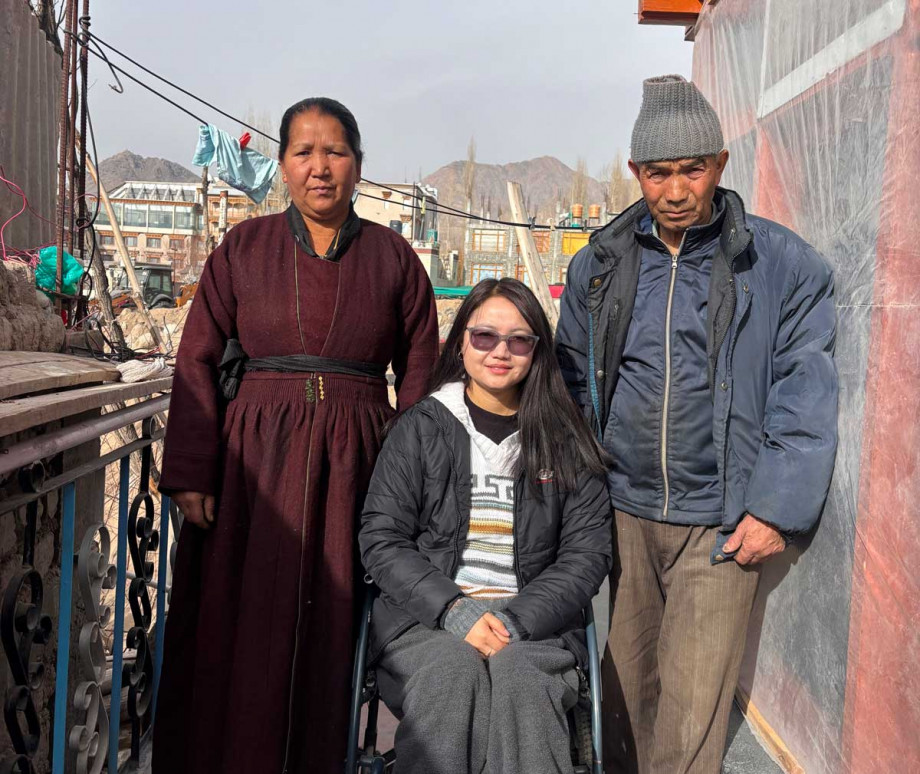
Q. Can you share your journey of living with a disability and how you overcame the challenges to reach where you are today?
Jullay, and thank you for having me. I am from Hemis Shukpachan and presently work as an Account Assistant in the Handicraft Department.
Talking about my disability, my mother told me that I was born with spinal defects. At that time, there was very little awareness about such conditions. Since there were no immediate complications, it went unnoticed. I had a small swelling on my spine, and when my mother consulted a doctor, he examined me thoroughly and found everything normal. He reassured my mother that I was fine and just needed to keep warm.
The years passed like this. When I was in class 3, I went out with friends in winter for ice skating. I slipped, and one of my legs got deformed. I was still able to walk, but my legs gradually worsened over time. I started feeling tired, unable to walk properly, and slowly began losing sensations in my legs. Seeking guidance, we consulted local oracles who advised against any treatment, saying everything would be fine.
One day, I met Rewa Society, and they informed me that therapy was crucial for my condition. I underwent therapy diligently until class 5. Later, they told me that I would need surgery. Along with me, 10 to 11 children with different conditions also went to Delhi for surgery.
In October 2008, I reached Delhi for surgery, but the appointment at AIIMS was scheduled for February—a long wait. We went to St. Stephen’s Hospital, where they agreed to operate the next day after reviewing my history and completing formalities. The surgery lasted 10 hours—I went in at 8 a.m. and came out at 6 p.m. When I woke up from heavy anesthesia, I saw my mother, worried and by my side the whole day. She asked me to eat, but I told her I was fine.
When I tried to move my body, I realized there was no sensation below my legs. I got scared and asked my mother, who was also frightened. The doctor reassured us that with therapy and time, I would recover.
One year passed with continuous therapy, but there was no improvement. When we consulted the doctor again, they told us it would take time. Coming from a middle-class family with little awareness or support, we lived with hope and continued therapy. I had to stop attending school, but the teachers allowed me to study at home and appear for exams. From class 6 to 8, I studied at home with the help of my tutor, Sir Tsewang Dorjay.
A physiotherapist from Germany, working with Rewa Society, studied my case and invited me to Germany for treatment. I initially hesitated, saying I was dependent and could not travel without my mother. In June 2011, I went to Germany with my mother. There, my deformed left leg was treated. I stayed in the hospital for one month and continued therapy for three months after discharge.
In 2012, I returned to Germany to receive prosthetic legs and crutches. In 9th standard, I rejoined school. I completed class 10 at Mahabodhi School and classes 11 and 12 at Lamdon School. I was fortunate to have supportive friends and am deeply grateful to my parents, who sacrificed so much and gave me unwavering care, time, and patience.
I studied agriculture for four years in Jammu and pursued a master’s degree in Delhi. Today, I am independent—financially and personally—and nothing would have been possible without the love, support, and sacrifices of my parents.
Q. In one of your videos, you mentioned that disability can happen to anyone, and the support of family and people around you is crucial. What would you like to share about this?
My mother has been with me through all the ups and downs of my life. When my health challenges began, she even left her job at ICDS to take care of me. From class 6 until now, she has been by my side constantly. My father managed all the household and societal responsibilities so that my mother could devote her time to me.
Even when I was studying in Jammu and Delhi, my mother stayed with me. The schools and hostels I attended were very supportive—they provided all necessary facilities and allowed my mother to stay with me. My siblings, friends, and everyone around me also gave immense support, which truly kept me going.
A person with a disability needs continuous support, encouragement, and patience to excel in life. Without my parents’ time, care, and dedication, I would not have reached where I am today.
Q. You are working with the Handicraft Department. Can you tell us about the importance of having disability-friendly infrastructure and the challenges faced in its absence?
I have always been concerned about accessibility, and I have emphasized its importance since my childhood on various occasions. Accessibility is vital for every person with a disability, as it greatly eases daily life.
When I first started coming to the office, I had to be carried up the stairs every day and needed help to use the washroom, which became very difficult for me. Although people were always willing to help, it was troublesome for everyone.
I am very grateful to the Assistant Director of the Handicraft Department, who understood my difficulties. I wrote a letter requesting accessibility improvements for moving around the office and using the washroom. The AD promptly forwarded it to the higher authorities, and within six months, a lift was installed. Within two months, a separate washroom was also constructed for me.
These facilities have greatly eased my life and given me independence. While I am fortunate to have my mother’s constant support, not everyone has such assistance. This is why disability-friendly infrastructure is essential—to allow people with disabilities to move, work, and live freely without constant dependence or worry.
Q. Despite facing physical challenges, you never gave up and prioritized your education, which is very important. What would you like to say about it?
When I think about it today, I feel proud of myself for never giving up and continuing my studies despite all the challenges I faced. Life could have been very difficult and limited if I had stopped studying. I have always been good at academics and used to participate in various co-curricular activities. Perhaps that is why the thought of giving up never even occurred to me.
The school’s support, allowing me to study at home and appear only for exams, also gave me no excuse to quit. With the help of a home tutor, I was able to study effectively and score well. My parents’ constant encouragement further motivated me to continue pursuing education.
Support from family, friends, teachers, and others at every level helped me keep moving forward and inspired me to achieve something meaningful. I had planned to pursue a PhD, but I got selected for a job in the meantime. I decided to work while keeping the dream alive for the future.
My message to everyone is: stay strong, no matter how much people may let you down. It’s all about living with your own strength. Never let anything stand in the way of your education—education is essential and can empower you to overcome all obstacles.
Q. Do you ever feel that if the disability issue had never existed, life could have been better with greater opportunities?
Life is uncertain; you never know what tomorrow holds. Disability is something that requires acceptance—you can’t just sit back, cry, or regret. It is a part of your life, and the focus should be on living in the present. I never dwell on “what could have been” or think that life would have been better otherwise. Instead, I focus on the present and make the best use of it.
Message to the Readers
Courage, acceptance, and education can turn life’s greatest challenges into strength. I feel it is important to have empathy, inclusion, and the creation of a society where everyone can live with dignity and independence.
-
 Reach Ladakh Skara Yokma, Airport Road, Near Councillor Quarter, India.


© 2018 Reachladakh. All rights reserved.
Web designs By : India Internet