


In Conversation with Padma Chorol, Ice Hockey Player
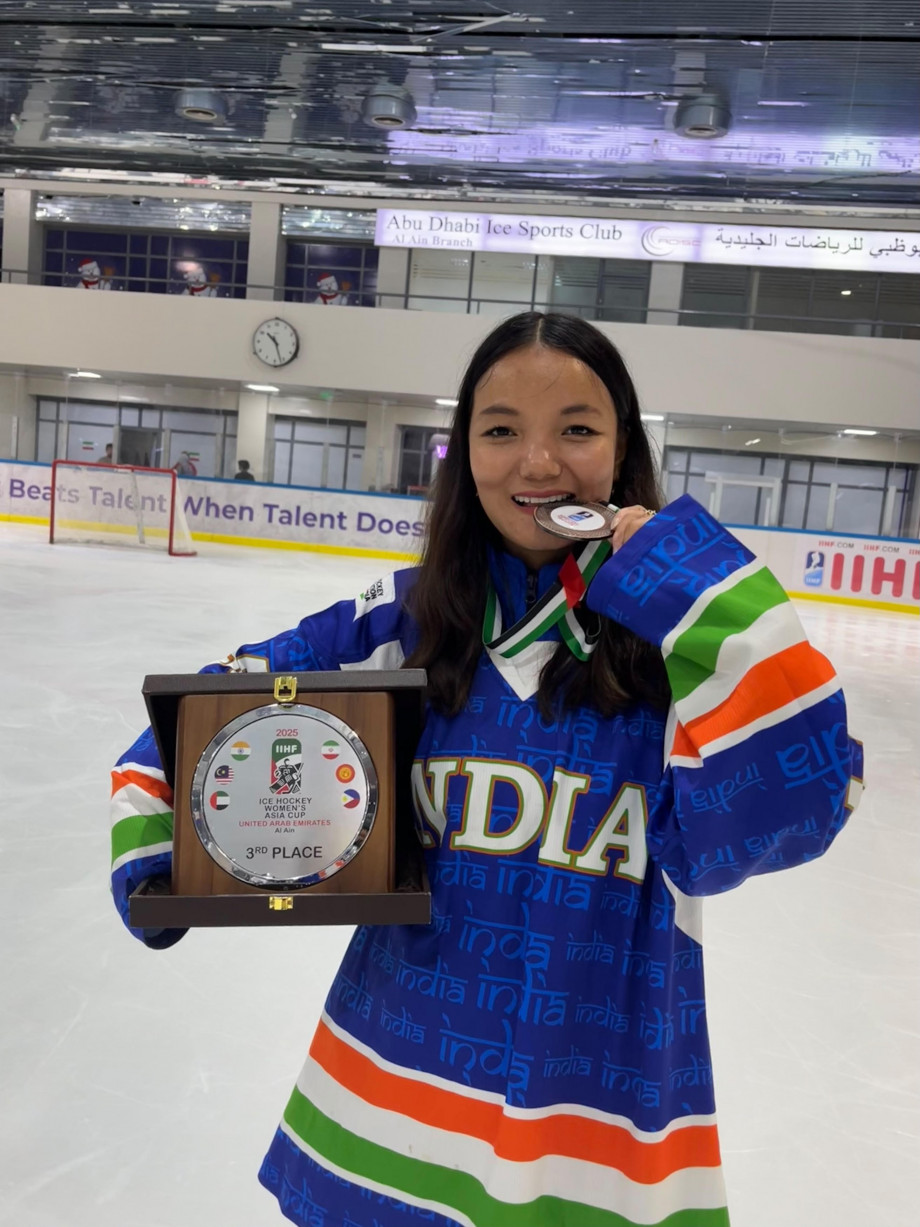
Q. Take us back to when you were 10. How did your journey in ice sports begin, and who encouraged you?
Jullay! First of all, I would like to thank the Reach Ladakh team for inviting me for this interview. I am Padma Chorol from Spituk. I completed my schooling at Moravian Mission School, Leh, and my higher secondary education at 16 Model School, Chandigarh. I later graduated in English Literature from Delhi College of Arts and Commerce, University of Delhi.
My journey began when I was just 10 years old in my village, Spituk. From a very young age, I was always attracted to snow and ice. I initially took up speed skating, which later became a strong foundation for my journey in ice sports.
My two brothers used to play ice hockey and were quite good at it. They were my biggest inspiration, along with the men's team. I would watch them play and always wanted to join them. However, at that time, very few girls played ice hockey, so I started with speed skating instead.
Later, I joined the Ladakh Winter Sports Club, which became one of my biggest supporters during the initial stage of my journey. The club encouraged me and gave me the opportunity to continue developing my interest in ice sports.
My brothers always encouraged me, but my mother was worried because she felt ice sports were risky and did not want me to participate. However, I was so passionate about playing that I would sometimes even run away with my brothers just to get onto the ice.
Looking back, those little moments marked the beginning of a journey that eventually took me much further than I had ever imagined.
Q. You started with speed skating and later moved to ice hockey. What were those early years like, especially when there were very few girls and limited facilities?
In the beginning, there were no proper facilities or opportunities for girls like there were for the boys. The boys used to have their own matches, equipment and teams, but for us girls they were very few opportunities. We didn’t even have proper women’s team, so we hardly got the chance to play matches.
Then there came a time when we started going to Secmol and asking girls if they were interested in playing ice hockey. Slowly, we got more girls together and formed two teams.
We would play matches between those two teams, and that was how we started getting some experience and opportunities to play as a women’s team.
Even the equipment was a challenge. We didn’t have our own equipment, so whenever we had matches, we used to borrow from the men’s team. Sometimes there were very basic things that we didn’t have, but still, we managed and continued playing because we really wanted to play the game.
I think all these challenges that we faced in the early stage of our journey made us stronger. We learned to adjust, support each other and keep going even when things were not easy. And despite having so few facilities and opportunities, our love for hockey kept growing. I feel those struggles played a big role in making us the players we are today.
Q. You became one of the first members of India’s women’s national ice hockey team in 2016. How did your life change after that?
2016 was a really big turning point in my life. I got the chance to be a part of the national team, and honestly, before that I never thought hockey would become such a big part of my life. In the beginning, I used to play it more as a hobby. I loved the game, but I never imagined that one day I would get the chance to represent India. Coming from a small village in Ladakh, it was a very big thing for me.
But when I got that opportunity in 2016, my whole thinking about hockey changed. I realised that now I had to be more focused and serious because I was not playing only for myself anymore. I had to represent my country, and that brought a completely different kind of responsibility.
I still remember the first time I wore the national team jersey. That feeling was different. I realised that people back home, especially young girls, could also look at us and think that they can do something like this. My vision towards the game changed completely.
From that time, I started giving my 100 percent to hockey. I wanted to improve, work harder and give my best whenever I played for India. For me, 2016 was the time when hockey stopped being just a hobby and became a dream, a responsibility and a very important part of my life.
Q. You started your journey at a very young age and went on to win two bronze medals. What challenges did you face along the way, and what were the most memorable moments of your journey?
We faced a lot of challenges. We had no proper infrastructure or equipment, but when we reached the international level and got the opportunity to represent our country, our eyes would fill with tears because it was such a big moment for us.
Natural ice and artificial ice are completely different. We had been playing on natural ice all our lives, and natural ice is much harder. We went to play on artificial ice, it was much smoother and completely different for us. Even during our first international match in 2016, we did not have proper equipment. Some of us had different sized skates, some had broken helmets, while others did not have elbow guards. Even the sticks we had were bigger compared to our body. We faced so many challenges like this.
One of the most historic moments for me was in 2019, when we won the challenge cup of Asia. Before that, we had never won a single international match. We had lost so many games, but even after those losses, we never lost hope. We remained dedicated and kept believing that we would win one day.
We got our first international win in 2017, and then in 2019, we won our first bronze medal at challenge cup of Asia. That was one of the best moments of my life. Whenever a team wins, the national anthem of that country is played. When it was our turn and our national anthem started playing, all of us started crying. We knew the challenges we had faced to reach that moment. When the others saw us crying, they also became emotional and started crying. It was a very special and historic moment for us, because we knew how far we had come. I will never forget that moment.
Q. Before we talk about the film, the entire reach Ladakh team would like to congratulate you on your acting debut in Bird’s on Ice. Your journey in ice hockey is now being brought to the screen. Could you tell us a little about the film and what it has been like to be a part of it?
The movie is based on hockey, and it is in the Ladakhi language and set in Ladakh. The producers are from Bombay, and recently we had the screenings. The film is also going to the Bussan international film festival for its premiere, which is a very big opportunity for us.
In the movie, I am playing the role of coach. I never thought that I would be part of a movie, but when I got this role, I felt it was something I could connect with. As an ice hockey player, I am also a mentor, so the role was quite close to what I have already been doing.
As part of the Ladakhi Women's Ice Hockey Foundation, we go to remote areas and villages and teach ice hockey, especially to the girls. So the role of coach was something I was already doing in real life, which made it easier for me to play the character. It was still a new experience for me because acting was something I had never done before, but because the role was connected to my own journey and the work I do, I could relate to it.
Q. Today you are a national and international level player as well as a mentor. How do you see ice hockey changing in Ladakh, and what advice would you like to give to the younger generation?
In Ladakh, sports have developed a lot over the years. If we compare the time when we started playing to today, there is a big difference. We can see development not only in ice hockey but in almost every sport. When we started, there were very limited facilities and infrastructure, but today we have better access to equipment and more opportunities for players to train and participate in competitions.
The number of players has also increased. Earlier, there were very few girls participating in sports, but today we can see many more girls coming forward and taking part. This is very positive change because when more girls participate, they also get the confidence to take sports seriously and think about it as a career. Recently, the government has also introduced a sports policy, which I feel will create more opportunities for athletes. There are opportunities related to employment, and players can also receive rewards and recognition for winning medals and performing well. Because of these kinds of opportunities, I think more people are now becoming interested in sports and parents are also encouraging their children to participate.
When I look back at our journey, we didn’t have many of these opportunities when we started. So, seeing the changes today makes me very happy, and I hope the facilities and opportunities continue to grow in the future.
My advice to the coming generation is that whatever field you choose, just focus on that and give your full effort. You will definitely face challenges, but don’t give up because of those challenges. Keep working, keep learning and stay dedicated. If you continue giving your best, one day the outcome will definitely come. Just believe in yourself and keep going.
Message to the readers
Continue to believe in yourself, embrace your journey, and never be afraid to dream big. Every experience, challenge, and opportunity has something to teach us. Keep learning, keep growing, and most importantly, stay true to who you are.
-
 Reach Ladakh Skara Yokma, Airport Road, Near Councillor Quarter, India.


© 2018 Reachladakh. All rights reserved.
Web designs By : India Internet