


In Conversation with Chhunzin Angmo, First visually impaired Woman to Scale Mount Everest
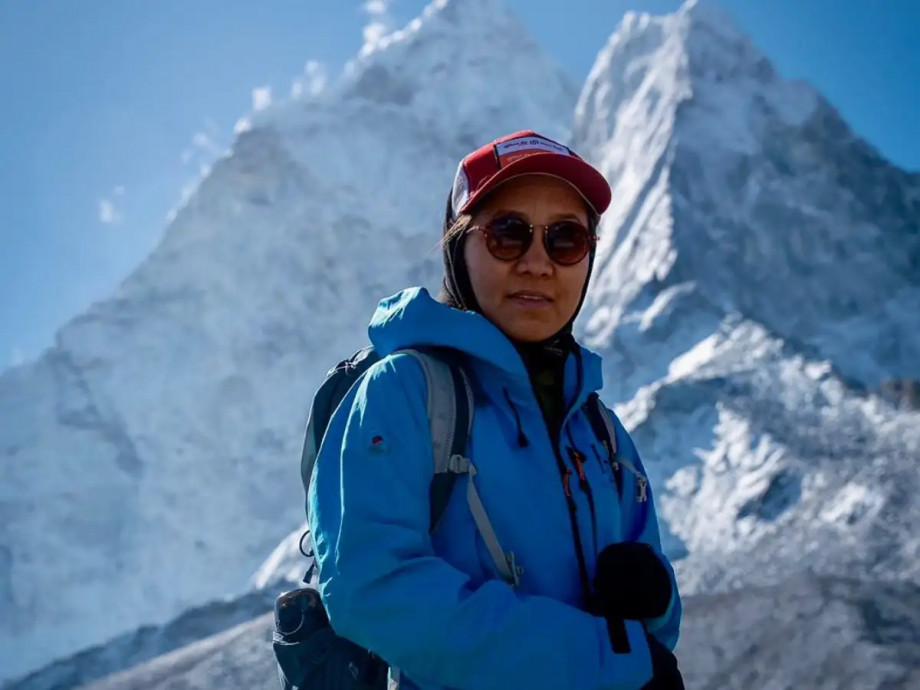
Q. Congratulations on becoming the first visually impaired woman to scale Mount Everest. Could you begin by telling us about your background and early life?
Jullay, and thank you to Reach Ladakh for giving me this opportunity to share my journey. I am from the Kinnaur district of Himachal Pradesh. I lost my eyesight at the age of 8 due to a reaction to medication. Later, I moved to Ladakh and completed my schooling at Mahabodhi Residential School. That opportunity truly gave me a second life, as it allowed me to continue my education.
I went on to complete my graduation and post-graduation from Miranda House, Delhi University. Currently, I am working with the Union Bank of India.
I have always been passionate about sports and adventure activities. I won a gold medal in swimming at the state level and participated in a national-level judo championship. I have also won two bronze medals in national-level marathon events, participated three times in the Delhi Marathon, as well as in the Pink Marathon and the Delhi Vedanta Marathon. In addition, I play football at the zonal and national levels, and I also engage in cricket, cycling, mountaineering, hiking, trekking, and other adventure sports.
Q. Being visually impaired, how did it shape your childhood, and what inspired you to keep going?
I come from a remote village with very little awareness about disability, and no one imagined that a visually impaired child could study. Losing my eyesight at 8 felt like the end of everything, but I was blessed with parents who supported and treated me just like my siblings. They never showed their worries and always encouraged me.
Joining Mahabodhi School in Leh changed my life. It gave me the opportunity to study and grow. I am grateful to Ven. Bhikkhu Sanghasena, my teachers, and friends who constantly motivated me, guided me, and helped me participate in different activities. Although I initially lacked confidence and felt different from other students, their continuous encouragement helped me overcome my hesitation.
The confident person I am today is because of the support of my parents, Ven. Bhikkhu Sanghasena, teachers, and friends.
Q. What first drew you to mountaineering — and when did the idea of climbing Mount Everest come to you?
During school, I read about Erik Weihenmayer, the first blind person to summit Mount Everest. I didn’t yet know much about mountaineering, but I was curious whether I could try it. Later, when I moved to Delhi for higher studies, I got a chance to enroll in a basic mountaineering course for both disabled and non-disabled individuals at Atal Bihari Vajpayee Institute of Mountaineering and Allied Sports (Manali, Himachal Pradesh). I was selected — and among 30 trainees, I received the “Best Training” award.
That experience made me realize mountaineering isn’t just about physical strength; it also builds mental resilience. On researching, I found that no visually impaired woman in India had yet climbed Everest. Previously, my plan was to prepare for the UPSC exam — but I saw a unique gap in mountaineering for disabled people. That difference appealed to me, and I decided to pursue the challenge.
I knew it would be tough, and when I shared my dream many people doubted me — saying if sighted climbers struggled, how would a visually impaired person succeed? Their reactions only strengthened my resolve. I was determined to prove that disability doesn’t define one’s limits.
Q. Tell us about the Everest journey — what was going through your mind?
Before attempting Everest, I pushed my limits through various expeditions. I cycled from Manali to Khardung La in 2018, completed a Nilgiris cycling expedition across three states in six days in 2019, and rode from Manali to Kalpa through Spiti and Kinnaur in 2023. I also climbed Mt. Kang Yatse II (6,250 m) in Ladakh and was part of a Divyang team that scaled an unnamed 6,000-metre peak. In 2021, I became the only woman with disabilities to be part of the team that scaled the Siachen Glacier under Operation Blue Freedom, setting a new world record.
For Everest, the biggest challenge was financial support, and I am deeply grateful to Union Bank of India for believing in me and sponsoring my expedition. When I reached the base, I saw other climbers who had prepared for years—training in gyms, hiring personal coaches—but I arrived with just a dream and determination. When people asked about my preparation, my honest answer was, “I just came.”
One of the toughest parts was crossing the ladders. For sighted climbers, it’s possible to stand and walk across, but for me, I had to crawl. When I asked my guide if it was safe, he simply said, “Do what feels comfortable.” I trusted his instructions, sensed his movements, and followed.
During the final summit push, exhaustion hit me hard. My body felt like it was shutting down, and I could barely lift my feet. I asked my guide for a break, but he refused because climbers behind us were moving in a single line, all clipped to the same rope. At that moment, I knew I couldn’t give up after coming so far.
Four things pushed me forward:
1. My long-held dream of climbing Everest — I finally had the chance to make it real.
2. The trust of Union Bank of India, who supported me financially.
3. The words of Romil Sir, who told me before the summit, “The real adventure starts now. Finish it calmly.”
4. My parents, friends, and the entire specially-abled community — I wanted to prove what we are capable of.
These four thoughts carried me to the top, and I realized that along with physical strength, mental endurance is what truly completes the journey.
Q. How did you feel when you reached the top of Mount Everest?
When I reached the summit, I just sat down and became emotional—realizing that I was finally standing on top of Mount Everest, the dream I had carried for so many years. I thanked the mountain for allowing me to climb and fulfill my dream. I felt immense gratitude for everyone who supported, encouraged, and prayed for me, and I silently wished for a safe descent.
Q. Tell us about your achievements.
I was honoured to receive the Sarvshresth Divyangjan National Award for the Empowerment of Persons with Disabilities from President Droupadi Murmu. I have also been awarded the NAB Madhu Sharma Young Achiever Award, the International Day of Persons with Disabilities Award from the National Association for the Blind, Delhi, and the Cavinkare Ability Mastery Award.
Q. What misconception about disability do you hope your story dispels?
I don’t expect 100 percent change, but even a small shift matters. People with disabilities face challenges of inclusion every day. When I started mountaineering, many were skeptical and questioned how a visually impaired person could do it. Today, through my achievements, I hope fewer people will hear those doubts and that society will begin to see ability beyond disability.
Q. Your achievement is historic. What message do you believe it sends about how society perceives disability, courage, and possibility?
I believe everyone has some form of limitation or “disability,” though it may not always be visible. Society should not judge people by their physical abilities but give everyone a chance to prove themselves. Failure is part of the journey, but discouragement should not be a barrier.
There is nothing in this world that we cannot achieve. With technological advancements and support, anyone can accomplish their goals. The key is to believe in us, encourage us, and provide opportunities, rather than focusing on our disabilities instead of our abilities.
Q. Now that you’ve stood on the highest point on earth, what are you planning to conquer next?
I aim to conquer the highest peaks on all seven continents, known as the Seven Summits. I have already completed two: Asia’s Mount Everest (8,848 m / 29,029 ft) and Europe’s Mount Elbrus (5,642 m / 18,510 ft). Next, I plan to climb Africa’s Mount Kilimanjaro (5,895 m / 19,341 ft). My goal is to make history as no visually impaired person has completed all seven summits so far.
Message to the readers
“My blindness is not my weakness—it is my strength. I want to tell all specially-abled people to focus not on their disabilities, but on their abilities. Once we overcome challenges and work on our strengths, nothing can stop us from achieving our dreams.”
-
 Reach Ladakh Skara Yokma, Airport Road, Near Councillor Quarter, India.


© 2018 Reachladakh. All rights reserved.
Web designs By : India Internet