


Chief Secretary reviews higher education sector, follow-up to Ladakh Education conclave
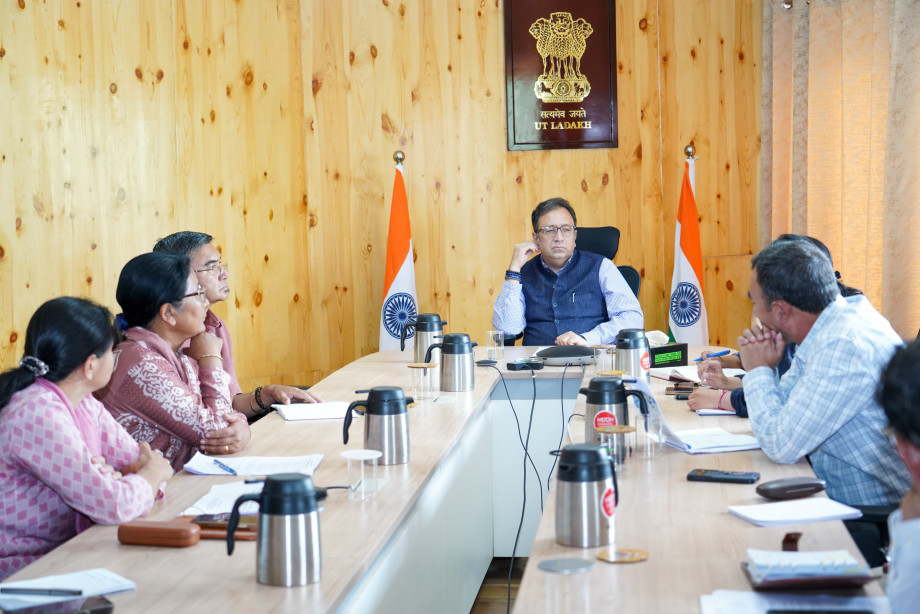
Chief Secretary, UT Ladakh, Ashish Kundra, on August 22 chaired a meeting to review the higher education landscape in Ladakh and assess follow-up action on key recommendations emerging from the Ladakh Education Conclave 2024.
The meeting focused on student enrolment, academic programmes, admissions, student aspirations, employability and measures to strengthen the quality of higher education institutions across the Union Territory.
Secretary, School Education Department, Bhanu Prabha, presented an overview of the current higher education scenario, covering enrolment, courses offered, skill development initiatives, academic credits and areas requiring focused attention. Faculty members and academic representatives also shared observations and suggestions on challenges faced by colleges, including students being unable to secure admission to preferred programmes due to limited seats, course availability and other admission-related factors.
The Chief Secretary emphasised the need for stronger academic coordination and regular interaction among colleges and universities in Ladakh. He called for greater faculty-level exchanges, brainstorming sessions and sharing of best practices to address academic challenges and expand opportunities for students within the UT.
The meeting examined why students continue to pursue higher education outside Ladakh despite the availability of colleges and institutions within the Union Territory. Kundra called for a systematic assessment of enrolment trends, vacant seats, admission patterns, course preferences and factors influencing students to study outside the region.
He stressed the need to determine whether such trends are linked to course availability, academic quality, professional opportunities, institutional capacity or other student preferences.
Reviewing undergraduate and postgraduate programmes, the Chief Secretary called for assessing courses based on their relevance, demand and employment potential. He emphasised the need to introduce professionally oriented and emerging disciplines while strengthening programmes suited to Ladakh’s specific requirements, including agriculture, horticulture, food technology and climate studies.
The meeting also reviewed the admission process in colleges and the University of Ladakh, including CUET and merit-based admissions. Kundra directed institutions to compile reliable data on admissions, enrolment and vacant seats and analyse gaps between available capacity and actual admissions.
He further called for developing a comprehensive database tracking the academic journey of students after Class XII in Ladakh, including the degree or professional programmes they pursue, institutions they join, reasons for studying outside the UT and their subsequent academic or employment outcomes.
He said such data would help institutions better align academic offerings with students’ aspirations and emerging employment opportunities.
The Chief Secretary stressed the importance of career counselling, mentorship, entrepreneurship and exposure programmes in colleges. He called for regular lecture series and interactions with successful professionals, entrepreneurs, alumni, local achievers and subject experts to help students make informed academic and career choices.
The role of alumni was also discussed, with emphasis on maintaining meaningful engagement with former students and documenting the progress of outstanding students pursuing higher studies or careers outside Ladakh. Kundra said such feedback could provide valuable inputs for improving academic programmes and institutional planning.
Emphasising continuous improvement in teaching and learning, the Chief Secretary called for periodic academic reviews and greater faculty participation in curriculum development. He stressed the need for colleges to assess teaching methods, ensure that programmes meet contemporary requirements and integrate technology and emerging fields into academic curricula.
The meeting also explored the potential for developing specialised programmes in areas where Ladakh has distinctive advantages. Climate studies emerged as a potential area of academic and research interest, given Ladakh’s unique geographical and environmental conditions and growing interest among researchers and students.
Kundra emphasised that the findings and data from the review should be used to identify gaps and formulate practical measures to make higher education in Ladakh more accessible, relevant and responsive to students’ aspirations.
The meeting was attended by Secretary, School Education Department, Bhanu Prabha; principals, assistant professors and faculty members from colleges; Vice Chancellor and faculty members of the University of Ladakh; and other concerned officials.
Representatives and faculty members from Kargil, Drass and other districts participated virtually.
-
 Reach Ladakh Skara Yokma, Airport Road, Near Councillor Quarter, India.


© 2018 Reachladakh. All rights reserved.
Web designs By : India Internet