


Multilingual Mushaira celebrates Ladakh’s literary diversity in Kargil
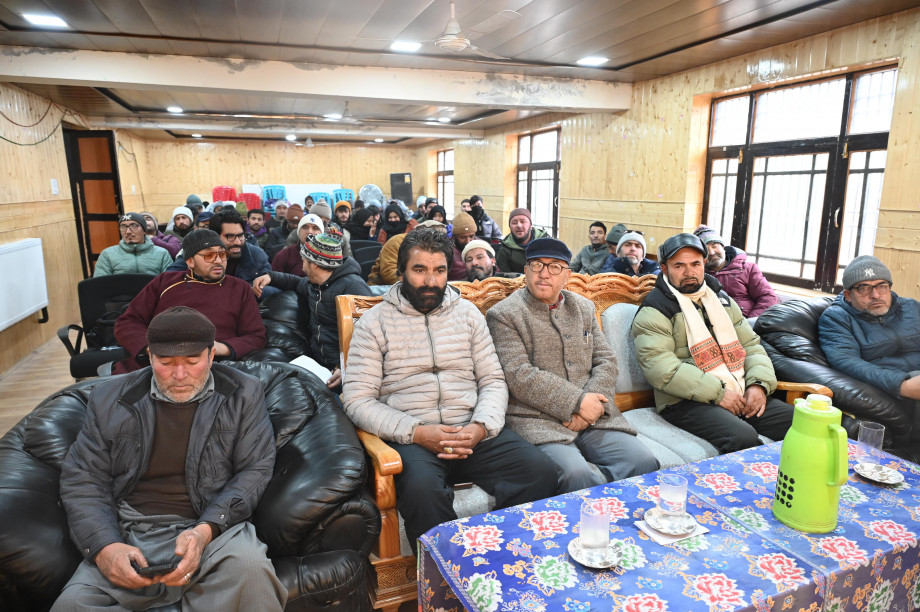
The two-day district-level multilingual Mushaira and Afsana Nigari sessions, organised by the Ladakh Academy of Art, Culture and Languages (LAACL), Kargil, under the theme Losar-e-Dus-Dang, concluded on December 31 at the Academy Hall, Kargil.
The literary session on the second day was chaired by senior Purgi/Balti poet Aga Syed Hadi Shah Aga. Senior Balti poet-writer and Padma Shri awardee Akhone Asgar Ali Basharat, Special Officer for Cultural Activities Kargil Muhammad Ali Tak, and senior Balti poet Akhone Safdar Ali Safdar were present in the presidium.
The event witnessed enthusiastic participation by poets and short story writers representing various languages and dialects of Ladakh. Poetry and short story presentations were made by Aga Syed Hadi Shah Aga (Purgi), Akhone Safdar Ali Safdar (Balti), Mohd Ali Ashoor (Balti), Tsewang Gailson (Broqskat Dardi), Ghulam Nabi Skith (Balti), Mohd Hussain Fayaz (Purgi), Arif Hussain Ladakhi (Sheena Dardi), Sibte Hassan Kaleem (Balti), Haji Ghulam Qadir Zaki (Sheena Dardi), Haji Ghulam Murtaza Advocate (Urdu), Prof Jawad Jalib (Purgi), Nissar Hussain Nissar (Purgi), Dr Mukhtar Zahid Badgami (Sheena Dardi), Prof Nasir-ud-Din Khafi (Purgi), Mohd Abbas Zameer (Purgi Afsana Nigar), Mohd Ilyas Matvi (Urdu Afsana Nigar), Mohd Yaseen Ansari (Sheena Dardi), and Aga Syed Kazim (Purgi/Balti).
During the session, poets and writers explored diverse themes such as cultural identity, social realities, humour, satire, spirituality, climate change, human existence, and contemporary challenges. Short stories delved into supernatural elements, human struggle, hope, and the triumph of life over death.
Several participants observed that culture today often survives more in books than in lived practice. Poetry on nature, weather, the New Year, global warming, and moral values resonated deeply with the audience.
The programme also featured Rgyang-Lu folk songs presented by renowned Purgi folk singer Fida Hussain Bajopa Silmoo, who narrated Ladakh’s history, the bravery of kings, love, social issues, and the various stages of human life—from youth to old age—evoking reflection and nostalgia.
Special Officer for Cultural Activities, Muhammad Ali Tak, stated that Losar-e-Dus-Dang is not merely a festival but a symbol of unity, cultural continuity, and shared heritage. Emphasising the significance of folk traditions like Rgyang-Lu, he informed that the Academy is working towards documenting and publishing literary works presented in vernacular languages during various literary events.
The programme concluded with a Sadarati Khutba delivered by Sadre-e-Majlis Aga Syed Hadi Shah Aga, who stressed the importance of learning, using, and preserving mother tongues and local dialects to safeguard cultural identity. He urged the younger generation to remain rooted in their linguistic heritage, describing language as the foundation of collective memory and cultural continuity.
Addressing LAACL Kargil officials, he appealed for the organisation of similar literary initiatives in schools, colleges, and universities to introduce young minds to creative expression in vernacular languages. He lauded the role of poets, writers, and the media in preserving cultural values, remarking that literature has the power to help society rediscover its “lost laughter.”
On the occasion, writers and poets proposed that LAACL Kargil organise dedicated literary gatherings to commemorate the contributions of late local writers and poets, ensuring their legacy continues to inspire future generations.
Tsewang Rigzin appealed to the public to celebrate Losar-e-Dus-Dang collectively, beyond divisions, stating that culture unites people like a bouquet of flowers symbolising peace and harmony. He expressed gratitude to the LAACL team, poets, writers, guests, and media persons for their support.
Writers, poets, students of Government Degree College, Kargil, and a large number of literary enthusiasts attended the event.
-
 Reach Ladakh Skara Yokma, Airport Road, Near Councillor Quarter, India.


© 2018 Reachladakh. All rights reserved.
Web designs By : India Internet